

How Preschool Builds Early Problem Solving Skills
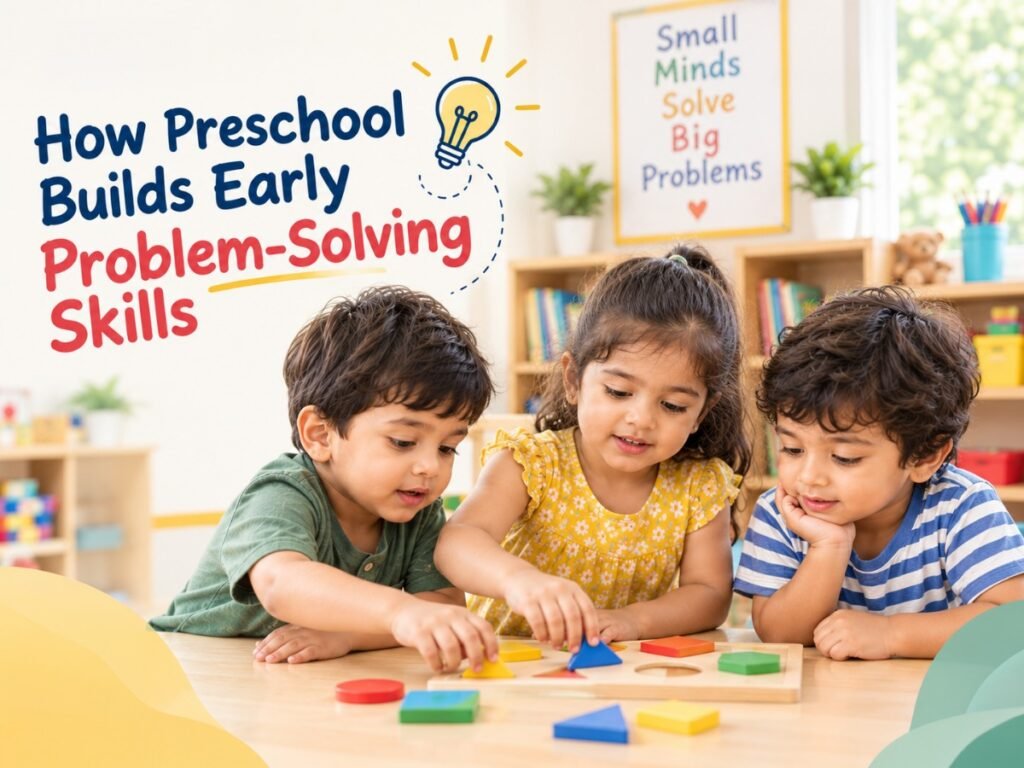
Problem-solving is an important skill children begin developing during their preschool years. At this age, children learn best when they can explore, experiment, ask questions, and find solutions on their own. Simple activities such as completing a puzzle, building with blocks, arranging objects, or finding another way to complete a task can give children valuable opportunities to think.
Preschool education can support this development by including problem-solving in everyday learning. Instead of always giving children the correct answer, teachers can encourage them to think about the problem, try different approaches, and learn from what happens. At Akshaya Bala Kuteera, engaging preschool activities can give children opportunities to explore ideas and develop early thinking abilities. These experiences help children gradually build problem solving skills for preschoolers in a natural and enjoyable way.
Why Are Problem-Solving Skills Important for Preschoolers?
Problem-solving helps children learn how to respond when something does not work as expected. At the preschool stage, problems are usually simple and connected to everyday activities. For example, a child may need to figure out which puzzle piece fits, how to make a block tower stand, or how to complete a pattern.
These experiences help children develop:
- Logical thinking: Understanding what may work and what may not.
- Decision-making: Choosing between different options.
- Creativity: Thinking of new ways to solve a problem.
- Concentration: Staying focused while working on a challenge.
- Persistence: Continuing to try when the first attempt does not work.
- Independent thinking: Developing confidence in their own ideas.
These abilities form an important foundation for future learning.
How Does Preschool Build Problem-Solving Skills?
Preschool can develop problem-solving through simple activities that encourage children to think and participate. Children do not need complicated tasks. They need opportunities to explore a challenge and decide what they can do.
Teachers can include problem-solving in:
- Puzzles and matching activities
- Building and construction play
- Sorting and sequencing games
- Storytelling
- Art and craft
- Pretend play
- Group activities
- Hands-on learning
Each activity gives children a chance to observe, think, make a choice, and see the result.
How Do Puzzles Develop Problem-Solving Skills?
Puzzles encourage children to look carefully at shapes, colours, pictures, and patterns. They need to decide which pieces belong together and where each piece should go. When a piece does not fit, children can try another option instead of giving up.
Puzzle activities help children develop:
- Observation skills
- Matching skills
- Logical thinking
- Concentration
- Decision-making
- Patience
For problem solving skills for preschoolers, puzzles are useful because children can immediately see whether their approach works.
How Does Block Play Encourage Problem-Solving?
Building blocks give children opportunities to create structures and solve practical challenges. A child may build a tower only to see it fall down. This creates an opportunity to think about what went wrong and what could be changed.
Children may:
- Use a wider base.
- Change the position of the blocks.
- Use different-sized blocks.
- Build a shorter structure.
- Try a completely different design.
Through this process, children learn about balance, stability, planning, and cause and effect while developing problem-solving skills.
How Does Sorting and Matching Help Children Think?
Sorting and matching activities encourage children to observe objects and identify similarities and differences.
Children may sort objects by:
- Colour
- Shape
- Size
- Type
- Pattern
They need to look at each object, compare it with others, and decide where it belongs. These activities support early logical thinking because children learn to use information before making a decision.
How Does Sequencing Develop Problem-Solving?
Sequencing activities ask children to understand order. They may need to arrange pictures according to what happens first, next, and last. For example, children might arrange pictures showing the steps involved in planting a seed.
Sequencing helps children understand:
- Order
- Patterns
- Connections
- Cause and effect
- Logical relationships
These skills can help children organise their thoughts when approaching simple problems.
How Does Play-Based Learning Build Problem-Solving Skills?
Play-based learning gives children opportunities to solve problems while doing activities they enjoy. Children naturally make decisions and adjust their actions during play. For example, during pretend play, children may need to decide how to organise their play area or how to share materials with others.
Play can encourage children to:
- Make their own choices.
- Try different ideas.
- Explore possible solutions.
- Change their approach.
- Work towards a simple goal.
Because children are actively involved, they can learn problem-solving through direct experience.
How Do Teachers Encourage Children to Find Solutions?
Teachers can support problem solving skills for preschoolers by guiding children instead of immediately solving every problem for them. When a child faces difficulty, a teacher can ask questions such as:
- “What could you try?”
- “Can you think of another way?”
- “What happened when you tried that?”
- “Which one might work better?”
- “What could we change?”
These questions encourage children to think about the situation and consider different possibilities. The teacher can provide help when necessary, but giving children time to think allows them to become more active problem-solvers.
How Do Art and Craft Activities Develop Problem-Solving?
Art and craft activities give children opportunities to make choices and experiment with different materials. A child may need to decide how to arrange shapes, which materials to use, or how to fix something that does not look or work as expected. For example, if a paper structure does not stand properly, the child can try changing its position or using another material.
Creative activities can help children develop:
- Flexible thinking
- Creativity
- Decision-making
- Planning
- Experimentation
There may be several possible solutions, which teaches children that problems do not always have only one answer.
How Does Storytelling Encourage Problem-Solving?
Stories can introduce children to characters who face simple problems. Teachers can pause during a story and ask children what the character could do next.
Story-based activities encourage children to:
- Think about possible solutions.
- Predict what might happen.
- Explain their ideas.
- Consider different choices.
- Use their imagination.
This makes storytelling a useful activity for developing early reasoning and problem-solving skills.
How Does Group Play Develop Problem-Solving?
Children often encounter simple problems when working with classmates. They may need to share materials, decide who will do a particular task, or agree on how to complete an activity. These situations encourage children to find solutions together.
Group activities can help children learn to:
- Listen to other ideas.
- Explain their own ideas.
- Take turns.
- Share materials.
- Make decisions together.
- Find solutions through cooperation.
Problem-solving in a group also teaches children that different people may have different ideas about the same situation.
How Do Games Develop Problem-Solving Skills?
Age-appropriate games can encourage children to think about what they should do next. Simple board games, matching games, memory games, and pattern games can provide small challenges. Children may need to remember information, follow a sequence, make a choice, or decide which move to make.
Games can therefore support:
- Memory
- Attention
- Logical thinking
- Decision-making
- Planning
- Following rules
The activity remains enjoyable while giving children opportunities to practise problem-solving.
How Do Mistakes Help Children Become Better Problem-Solvers?
Children do not always find the correct solution on their first attempt. A puzzle piece may be wrong, a tower may fall, or a chosen method may not work. These moments can become useful learning experiences.
When children are encouraged to try again, they learn to:
- Identify what did not work.
- Think about what they could change.
- Try another approach.
- Stay patient.
- Continue working towards a solution.
This teaches children that mistakes are part of the problem-solving process.
How Does Hands-On Learning Support Problem-Solving?
Hands-on activities allow children to learn through direct experience. Instead of only listening to an explanation, children can touch, move, arrange, build, and experiment with objects. For example, children can discover how different objects fit together by actually putting them together. They can also experiment with materials to see what happens when they change something.
Hands-on learning encourages children to:
- Explore possibilities.
- Test their ideas.
- Observe results.
- Make changes.
- Find practical solutions.
These experiences make problem-solving more meaningful for young children.
How Does Preschool Encourage Independent Problem-Solving?
Children need opportunities to think for themselves. During preschool activities, teachers can give children simple choices and allow them to decide how they want to approach a task. Instead of immediately showing a child what to do, a teacher can provide a small hint or ask a question.
This helps children practise the process of:
Understand the problem → Think of an idea → Try it → Observe the result → Try another solution
With regular practice, children can become more confident in handling simple challenges independently.
What Are the Benefits of Developing Problem-Solving Skills Early?
Early problem-solving experiences can support several areas of children’s learning and behaviour.
They can help children develop:
- Better logical thinking
- Greater curiosity
- More confidence when trying new activities
- Stronger decision-making abilities
- Greater persistence
- Creative thinking
- Independent learning
- Better cooperation during group activities
These abilities develop gradually through repeated experiences rather than through one particular activity.
How Can Preschool Make Problem-Solving Fun?
Problem-solving activities should feel like an enjoyable part of learning rather than a difficult task. Teachers can turn simple challenges into playful activities. Children might be asked to build a bridge for a toy, complete a pattern, find a missing puzzle piece, or create a structure that can stand on its own. The focus should be on how children think and explore, not simply whether they find the correct answer. When children enjoy the process, they are more likely to experiment, ask questions, and keep trying.
Conclusion
Preschool provides many opportunities to develop problem solving skills for preschoolers through simple, engaging, and age-appropriate activities. Puzzles, block play, sorting, sequencing, storytelling, games, creative activities, and hands-on learning all encourage children to observe, think, make decisions, and find solutions. The role of preschool education is not simply to provide children with answers. It is also to give them opportunities to explore different possibilities and understand that a problem can often be solved in more than one way.
With encouragement from teachers and regular opportunities to practise, children can gradually develop logical thinking, creativity, persistence, and independent thinking. At Akshaya Bala Kuteera, children can explore and learn through engaging activities that encourage active participation and early thinking skills. These experiences can help create a strong foundation for problem-solving during the preschool years and beyond.
Frequently Asked Questions
1. What are problem-solving skills for preschoolers?
Problem-solving skills for preschoolers are the abilities children use to understand simple challenges, think about possible solutions, make decisions, and try different approaches.
2. How does preschool develop problem-solving skills?
Preschool develops problem-solving through puzzles, block play, sorting, sequencing, storytelling, games, art and craft, group activities, and hands-on learning.
3. What activities improve problem-solving skills for preschoolers?
Puzzles, building blocks, matching games, sorting activities, pattern games, storytelling, pretend play, and simple construction activities can help children practise problem-solving.
4. How do teachers encourage problem-solving in preschool?
Teachers can ask guiding questions, provide age-appropriate challenges, give children time to think, and encourage them to try another approach when their first attempt does not work.
5. Why are mistakes important in problem-solving?
Mistakes give children an opportunity to understand what did not work and try a different approach. This helps them develop persistence and confidence.