

Why Children Sometimes Need Time Before Joining Group Activities
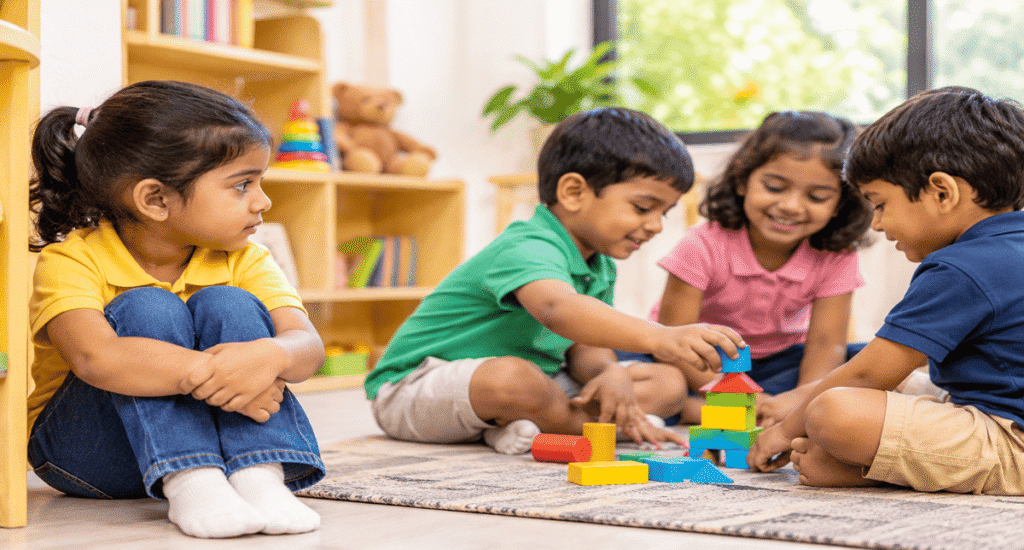
Every child has a different way of learning, communicating, and interacting with others. While some children happily join classroom games and group activities, others prefer to observe before becoming involved. This is a natural part of preschool social development. At Akshaya Bala Kuteera, children are encouraged to explore, learn, and interact at their own pace. Preschool group activities provide opportunities to communicate, share, cooperate, and build friendships. However, some children may need extra time to feel comfortable in a group setting, understand the activity, or become familiar with their classmates. Giving children this time helps them develop confidence and enjoy learning with others.
1. Why Do Some Children Hesitate to Join Group Activities?
Not every child feels comfortable in a group environment immediately. Some children enjoy individual play, while others need time to understand how group activities work. This does not necessarily mean they dislike being around other children.
There can be several reasons behind this behaviour:
Unfamiliar surroundings: A new classroom, teacher, or group of children may make a child feel unsure.
Different personalities: Some children naturally take more time to interact with others.
Fear of making mistakes: A child may hesitate because they are unsure whether they can complete the activity.
Limited social experience: Children who have had fewer opportunities for group play may need time to understand how to participate.
Preference for observation: Some children enjoy watching others before deciding to join.
In such situations, preschool group activities should provide a welcoming environment where children can become comfortable without feeling forced to participate.
2. How Does Observing Others Help Children Learn?
Before joining an activity, some children prefer to watch their classmates. They observe how other children play, follow instructions, share materials, and communicate with one another. This observation is also a form of learning. Children gradually understand what is expected and become familiar with the activity before trying it themselves.
Learning through observation helps children:
Understand how an activity is performed.
Learn simple rules and instructions.
Observe how classmates communicate.
Become familiar with sharing and taking turns.
Feel more prepared before participating.
Teachers can support this process by allowing children to observe and offering a friendly invitation when they appear ready.
3. Can New Environments Affect Children's Group Participation?
Yes. A new environment can influence how comfortable a child feels around other people. When children enter preschool for the first time, they experience several changes. They meet new teachers, interact with unfamiliar classmates, follow classroom routines, and take part in different learning experiences.
These changes may take time to become familiar. Some children may participate in activities immediately, while others may prefer to stay close to their teachers or observe their classmates. During this adjustment period, preschool social development involves more than learning to communicate. Children are also becoming familiar with their surroundings and building trust with the people around them.
A supportive classroom can make this transition easier through:
Introducing activities in a simple and friendly way.
Maintaining familiar classroom routines.
Encouraging children to interact in small groups.
Providing opportunities for individual and group play.
Creating positive relationships between teachers and children.
When children become familiar with their classroom, participating in group activities can feel more comfortable.
4. Does Emotional Readiness Affect Group Activities?
Emotional readiness plays an important role in how children respond to social situations. A child may understand an activity but still feel uncomfortable participating. They might be worried about joining an unfamiliar group, sharing materials, or communicating their ideas. Early childhood social development includes learning to recognise feelings, express emotions, and gradually become comfortable interacting with others.
Teachers can support emotional readiness by:
Acknowledging children’s feelings instead of dismissing them.
Offering encouragement without forcing participation.
Allowing children to join activities gradually.
Appreciating small efforts, such as sitting with a group or sharing materials.
Providing reassurance when children feel unsure.
These small experiences help children develop social confidence and feel more secure in their learning environment.
5. How Do Different Play Activities Build Social Confidence?
Children often become more comfortable with group participation when activities are interesting, enjoyable, and suitable for their developmental stage. Play-based learning gives children opportunities to interact naturally rather than treating every social interaction as a task. Different preschool group activities can encourage children to participate in ways that match their interests.
Some examples include:
Building blocks: Children can start by building individually and gradually work together to create a larger structure. This encourages sharing, communication, and cooperation.
Storytelling sessions: Listening to stories and discussing characters gives children opportunities to express their thoughts and listen to others.
Music and movement: Simple songs, actions, and dance activities help children participate through movement, even when they are not ready to speak in front of a group.
Art and craft activities: Children can explore colours, shapes, and materials together while developing creativity and sharing skills.
Pretend play: Playing shopkeeper, teacher, or doctor helps children understand different roles and practise simple conversations.
These activities make social interaction more enjoyable. Children can gradually move from watching and exploring to actively participating with their classmates.
6. What Can Teachers Do to Encourage Group Participation?
Teachers play an important role in helping children feel comfortable in a classroom. Their approach can influence how children respond to group learning experiences. Instead of expecting every child to participate immediately, teachers can create opportunities that make joining activities easier.
Some helpful approaches include:
Start with smaller groups: A child who feels uncomfortable in a large group may find it easier to interact with two or three classmates.
Connect activities with children’s interests: If a child enjoys drawing, teachers can introduce a simple drawing activity involving other children.
Give simple instructions: Clear and easy instructions help children understand what they need to do.
Encourage without pressure: A friendly invitation can make a child feel included without making participation compulsory.
Appreciate small efforts: Joining a group, sharing a toy, or responding to a classmate can all be meaningful steps.
Provide regular opportunities: Repeated exposure to enjoyable group activities helps children become familiar with classroom interactions.
At Akshaya Bala Kuteera, play-based learning and age-appropriate activities provide opportunities for children to explore their interests, interact with classmates, and develop social skills.
7. How Can Parents Support Children Outside Preschool?
Children develop social confidence through everyday experiences at home and in their surroundings. Parents can support preschool social development by providing simple opportunities for children to interact with others. There is no need to make every interaction a formal learning activity. Everyday experiences can help children become more comfortable communicating and participating.
Here are a few practical ways parents can help:
Arrange playtime: Give children opportunities to play with cousins, friends, or familiar children.
Encourage sharing: Simple activities such as sharing toys or arranging blocks together can introduce cooperation.
Read stories together: Discussing characters and their actions helps children express thoughts and understand feelings.
Play simple group games: Activities like passing a ball, building puzzles, or singing action songs encourage interaction.
Avoid comparisons: Every child develops social confidence differently. Comparing one child with another may create unnecessary pressure.
Talk about daily experiences: Ask simple questions about what they enjoyed, whom they played with, or what they observed at preschool.
Parents should also remember that children do not need to participate in every activity to demonstrate progress. Sometimes, observing, listening, and becoming familiar with others are important steps towards interaction.
Why Is It Important to Respect Every Child's Pace?
Children do not develop social skills in exactly the same way or at the same speed. Some quickly become comfortable in group settings, while others need more opportunities to observe, explore, and build relationships.
Respecting these differences helps create a positive learning experience.
When children receive patient guidance and encouragement, they get opportunities to develop:
Confidence in communicating with others.
Comfort in unfamiliar social situations.
Sharing and turn-taking skills.
Cooperation during group learning.
Positive relationships with classmates.
Independence in making simple decisions.
The purpose of preschool group activities is not to make every child behave in the same way. It is to provide meaningful opportunities for children to learn, interact, and grow together.
Give Children the Time and Space to Grow
Every child deserves an environment where they feel comfortable exploring, learning, and expressing themselves. Some children may join group activities quickly, while others need time to observe, understand, and build confidence. Both experiences are part of individual development. At Akshaya Bala Kuteera, children are encouraged to discover their abilities through play-based learning, creative activities, and meaningful classroom experiences. With individual care, patient guidance, and opportunities to interact with classmates, children can gradually become more comfortable with group participation.
For parents looking for a supportive preschool in Nagadevanahalli, Bangalore, Akshaya Bala Kuteera focuses on providing a nurturing learning environment where every child gets the opportunity to grow at their own pace.
Akshaya Bala Kuteera – Helping little learners explore, connect, and grow with confidence.
Frequently Asked Questions
1. Why do some children avoid group activities at preschool?
Some children may feel uncomfortable in unfamiliar surroundings, prefer individual play, or need time to understand the activity. Observing others before participating can also be part of their learning process.
2. How can preschool group activities improve social skills?
Group activities give children opportunities to share, communicate, cooperate, take turns, and interact with classmates. These experiences support social confidence and early communication skills.
3. Is it normal for preschoolers to watch before joining an activity?
Yes. Some children prefer to observe how an activity works before participating. Watching classmates can help them understand instructions, learn from others, and feel more prepared.
4. How can teachers encourage shy children to participate?
Teachers can introduce small-group activities, provide simple instructions, connect activities with children’s interests, and offer gentle encouragement. Children should be given opportunities to participate without unnecessary pressure.
5. What are some good group activities for preschoolers?
Building blocks, storytelling, music and movement, art and craft, pretend play, and simple team games are useful activities. They encourage interaction while making learning enjoyable.