

Process-Based Learning in Preschool: 7 Key Benefits for Children
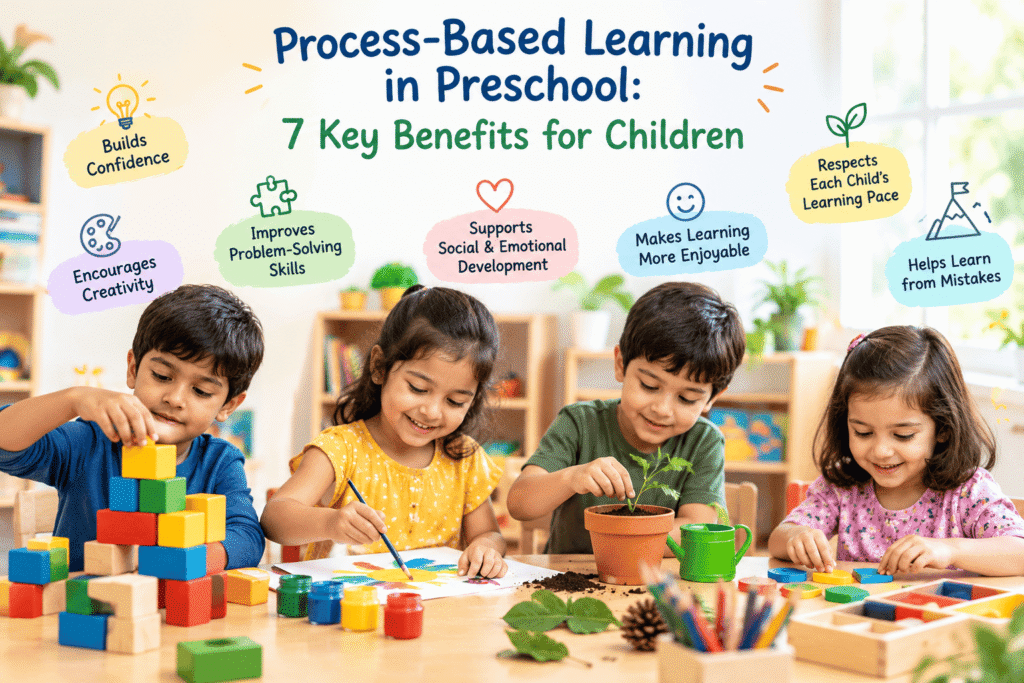
Every child learns differently. Some children enjoy drawing, while others love building with blocks, exploring nature, solving puzzles, or asking questions. In preschool, the way children explore and discover new things can be just as important as the final result. This is why process-based learning in preschool plays an important role in early childhood development.
At Akshaya Bala Kuteera, learning is about more than completing an activity perfectly. It is about encouraging children to participate, think independently, express their ideas, and enjoy the learning process. Through play-based learning, guided experiences, and creative activities, children get opportunities to discover their interests and develop skills at their own pace.
When children focus on the process rather than perfection, they become more comfortable making mistakes, trying again, and learning from experience. This approach supports creativity in early childhood, confidence, and problem-solving skills in preschool, helping children build a strong foundation for future learning.
What Is Process-Based Learning in Preschool?
Process-based learning in preschool is an educational approach that focuses on how children learn rather than judging their learning only by the final outcome. It encourages children to explore ideas, ask questions, test different solutions, and learn through hands-on experiences. This is the foundation of process oriented learning. Children are given the freedom to experiment while teachers guide them towards meaningful discoveries.
Unlike activities that focus mainly on perfect handwriting, identical artwork, or correct answers, this approach values effort, curiosity, participation, and progress. It also supports child centred learning, where children’s interests, abilities, and individual needs guide their learning experiences. Process-based learning in preschool is an educational approach that focuses on how children learn rather than judging their learning only by the final outcome. It encourages children to explore ideas, ask questions, test different solutions, and learn through hands-on experiences.
This is the foundation of process-oriented learning. Children are given the freedom to experiment while teachers guide them towards meaningful discoveries. Unlike activities that focus mainly on perfect handwriting, identical artwork, or correct answers, this approach values effort, curiosity, participation, and progress. It also supports child-centred learning, where children’s interests, abilities, and individual needs guide their learning experiences.
Why Does the Learning Process Matter More Than Results?
Young children are still developing their physical, social, emotional, and thinking skills. They need opportunities to practise, make mistakes, and discover new ways of doing things. Focusing only on results can make children feel that getting something wrong is a failure. In contrast, process-based learning in preschool helps children understand that learning takes time and that mistakes are a normal part of growth.
Here are three important reasons why the learning process matters:
Every child develops differently: Children have different interests, strengths, and learning speeds.
Learning becomes meaningful: Children understand concepts better when they explore and experience them instead of simply memorising information.
Confidence grows through effort: Children learn to value their attempts and become more willing to try unfamiliar activities.
What Are the 7 Benefits of Process-Based Learning?
1. How Does It Build Confidence?
Children develop confidence when they feel free to try something without worrying about making mistakes. In a supportive preschool environment, they can share ideas, attempt new tasks, and learn through practice. When teachers acknowledge effort and progress, children begin to trust their abilities. They become more comfortable participating in classroom activities and exploring unfamiliar experiences.
Why it matters: Confidence encourages children to take initiative, express themselves, and approach future learning experiences with a positive attitude. It also helps develop a growth mindset in children, encouraging them to see practice and effort as important parts of learning.
2. How Does It Encourage Creativity?
Creativity develops when children have the freedom to imagine, experiment, and make their own choices. In early childhood education, creative learning should not always require children to produce identical results. Consider a painting activity. Instead of asking every child to paint the same picture using the same colours, teachers can provide different materials and let children create their own designs. One child might paint a colourful garden, while another creates an imaginary animal. Both children practise decision-making, explore colours, and express their thoughts.
Hands on learning activities can encourage creativity through:
Drawing, painting, and art and craft.
Building structures with blocks.
Exploring textures and natural materials.
Creating stories and imaginary characters.
These preschool activities allow children to develop imagination, express emotions, and discover their individual interests. The focus remains on exploration and self expression rather than producing a perfect picture.
3. How Does It Improve Problem-Solving Skills?
Problem solving is an important part ofChildren learn to identify challenges, consider different options, and try possible solutions when they are given opportunities to explore independently. For instance, children building a bridge with blocks may discover that their structure falls when they add more blocks. They can experiment with wider bases, different arrangements, or stronger support.
The teacher does not need to provide the answer immediately. Instead, asking questions such as “What could make your bridge stronger?” encourages children to think for themselves. Through experiential learning in preschool, children gradually develop observation, reasoning, decision-making, and problem-solving skills in preschool. These experiences also introduce children to the idea that there can be more than one way to approach a challenge.
4. How Does It Teach Children to Learn From Mistakes?
Mistakes are a natural part of learning. However, children need a supportive environment to understand that getting something wrong does not mean they cannot succeed. Suppose a child is learning to arrange beads by colour and accidentally creates a different pattern. Rather than immediately correcting the mistake, the teacher can encourage the child to look at the arrangement and try again.
This helps children understand what happened and explore alternative approaches. Over time, learning from mistakes can help children become more patient, adaptable, and willing to attempt challenging activities. Teachers and parents can support a growth mindset in children by using encouraging statements such as:
You tried a different way this time.
What did you discover while doing this?
Let’s see what happens if we try again.
You are learning something new every time you practise.
When mistakes are treated as learning opportunities, children become more willing to explore, experiment, and persist through challenges. The goal is not to avoid mistakes but to help children understand what they can learn from them.
5. How Does It Support Social and Emotional Development?
Preschool is an important stage for developing social interaction and emotional understanding. Children begin learning how to share materials, wait for their turn, communicate their needs, and work with others. Process-based learning naturally creates opportunities for social emotional development. During a group activity, children may have different ideas about how to build a structure or complete a drawing. They learn to listen, explain their thoughts, negotiate, and cooperate to reach a shared goal.
These experiences help develop:
Communication skills: Expressing thoughts and listening to others.
Emotional regulation: Managing disappointment when an activity does not go as planned.
Cooperation: Sharing materials and working towards a common goal.
Empathy: Understanding that other children may have different feelings and ideas.
By focusing on participation and collaboration rather than competition, play-based learning can help children build healthier relationships and become more comfortable in group settings.
6. How Does It Make Learning More Enjoyable?
Children are naturally curious about the world around them. They often learn best when they can touch, observe, move, ask questions, and participate actively. Learning through play uses this natural curiosity to make learning engaging and meaningful. The activity combines science, language, observation, and responsibility without relying only on worksheets or memorisation.
Other examples include counting objects while playing, identifying shapes during building activities, and learning new words through storytelling. These forms of learning through exploration in preschool help children connect new ideas with real experiences. When children enjoy what they are doing, they are more likely to participate actively and remain interested in discovering new things.
7. How Does It Respect Each Child's Learning Pace?
Not every child develops the same skills at the same time. One child may quickly recognise letters, while another may need more practice. Some children communicate confidently in groups, while others prefer to observe before participating. Process-oriented learning recognises these individual differences and allows children to develop gradually. Teachers can support children by offering suitable activities, providing encouragement, and adjusting the level of guidance according to their needs.
The goal is not to compare children’s abilities but to recognise their progress and provide opportunities for further development. This child-centred learning approach supports a positive learning experience and helps children develop confidence without feeling pressured to match someone else’s pace.v
What Activities Encourage Process-Based Learning?
Preschool activities can introduce process-based learning through simple, engaging experiences. The focus should be on giving children opportunities to explore, make decisions, and learn from their experiences.
Here are some practical examples.
Building with blocks: Children experiment with height, balance, shapes, and structures. When a tower falls, they can try different ways to rebuild it.
Open-ended art activities: Children explore colours, materials, and patterns while creating individual artwork. The focus is on self-expression rather than producing identical pictures.
Nature exploration: Collecting leaves, observing insects, and planting seeds encourage curiosity, observation, and questions about the natural world.
Sorting and matching games: Children group objects by size, colour, shape, or other features. They learn to recognise patterns and explain their choices.
Pretend play: Setting up a pretend shop, kitchen, or clinic allows children to develop imagination, language, cooperation, and social understanding.
Simple science experiments: Activities involving water, floating objects, or mixing colours encourage children to make predictions and observe results.
These activities demonstrate how hands on learning and learning through play can support different aspects of early childhood development. In each activity, the teacher’s role is to provide suitable materials, encourage exploration, ask thoughtful questions, and help children reflect on what they discover.
How Can Teachers Encourage Process-Based Learning?
Teachers play an important role in creating a classroom where children feel comfortable experimenting and expressing themselves. The right guidance helps children stay engaged without taking away their independence.
A few useful practices include:
Ask open-ended questions: Questions such as “What do you think will happen?” encourage children to explore ideas.
Praise effort and progress: Recognise persistence, curiosity, and creative thinking rather than focusing only on correct answers.
Allow children to make choices: Offer different materials and let children decide how to approach an activity.
Provide time for exploration: Avoid rushing children towards a finished product when they are still discovering how something works.
Observe individual progress: Notice changes in confidence, communication, coordination, and problem-solving.
Encourage reflection: Ask children what they enjoyed, what they found difficult, and what they might try next.
These practices help create an environment where learning is active, supportive, and suited to children’s developmental needs. They also allow teachers to understand how each child approaches challenges and which skills may need further encouragement.
How Can Parents Support This Learning Approach at Home?
Parents can reinforce process based learning in preschool through everyday activities. Expensive toys or complicated projects are not necessary. Simple opportunities to explore and participate can be valuable. During these activities, allow children to attempt tasks independently when it is safe to do so. Instead of correcting every small mistake, offer guidance and encourage them to think about possible solutions.
Parents can also ask simple questions:
What was your favourite part?
What happened when you tried that?
Would you like to try another way?
What would you like to make next?
Most importantly, avoid comparing a child’s work with that of siblings or classmates. Recognising individual effort helps children feel supported and encourages a healthy attitude towards learning. When home and preschool experiences both value curiosity and effort, children receive consistent encouragement to explore new ideas and develop confidence.
How Can Parents Recognise Meaningful Learning in Preschool?
A child’s learning cannot always be measured by a completed worksheet, a perfect drawing, or the number of correct answers. Parents can also look at the skills children develop while participating in activities. Meaningful progress may include a child who begins sharing materials, asks more questions, tries a difficult task again, or explains an idea more clearly.
Parents can ask teachers about the experiences their children enjoy, the challenges they are learning to manage, and the skills they are gradually developing. This gives families a broader understanding of early childhood development and helps them appreciate progress that may not be visible in a finished project.
Conclusion
Early childhood is a time for discovery, experimentation, and gradual development. When children are encouraged to focus on the learning process rather than achieving perfect results, they have more opportunities to build confidence, creativity, problem-solving skills, and emotional resilience. Process-based learning in preschool reminds us that a child’s progress involves much more than what they produce at the end of an activity. Every question asked, challenge attempted, and new idea explored can contribute to meaningful learning.
At Akshaya Bala Kuteera, the focus is on making learning enjoyable while encouraging children to explore, participate, and grow at their own pace. Through play-based learning, guided activities, and opportunities for discovery, Akshaya Bala Kuteera supports children’s development and helps them build a positive foundation for lifelong learning.
Frequently Asked Questions
1. What Is Process-Based Learning in Early Childhood Education?
Process-based learning in preschool focuses on the steps children take while learning, including exploring, experimenting, solving problems, and reflecting. It values effort and progress alongside the final result.
2. Why Is Play-Based Learning Important in Preschool?
Play-based learning allows children to explore concepts through enjoyable, hands-on experiences. It can support creativity, communication, problem-solving, social interaction, and other important developmental skills.
3. What Is the Difference Between Process-Based and Product-Based Learning?
Process-based learning focuses on how children explore and develop skills during an activity. Product-based learning places greater emphasis on the finished outcome. Both approaches can have a place in preschool, but children also need opportunities to experiment without pressure to produce perfect results.
4. How Can Parents Encourage Learning Without Focusing on Perfection?
Parents can praise effort, allow children to make age-appropriate choices, encourage them to try again, and treat mistakes as opportunities to learn. Asking open-ended questions can also help children develop independent thinking skills.
5. Does Process-Based Learning Help Develop a Growth Mindset?
Yes. When children are encouraged to practise, explore different solutions, and learn from mistakes, they can begin to understand that skills improve with effort and experience. This can support a growth mindset in children.
6. How Can I Choose a Preschool That Supports Process-Based Learning?
Look for a preschool that offers hands-on activities, play-based learning, supportive teachers, opportunities for creative expression, and attention to individual development. Ask how teachers observe children’s progress beyond completed worksheets and finished projects.
7. What Is the Role of Teachers in Process-Based Learning?
Teachers provide suitable materials, guide exploration, ask open-ended questions, and encourage children to think independently. They also observe children’s progress and adapt activities to support different interests and developmental needs.