

How Indoor and Outdoor Play Support Child Development
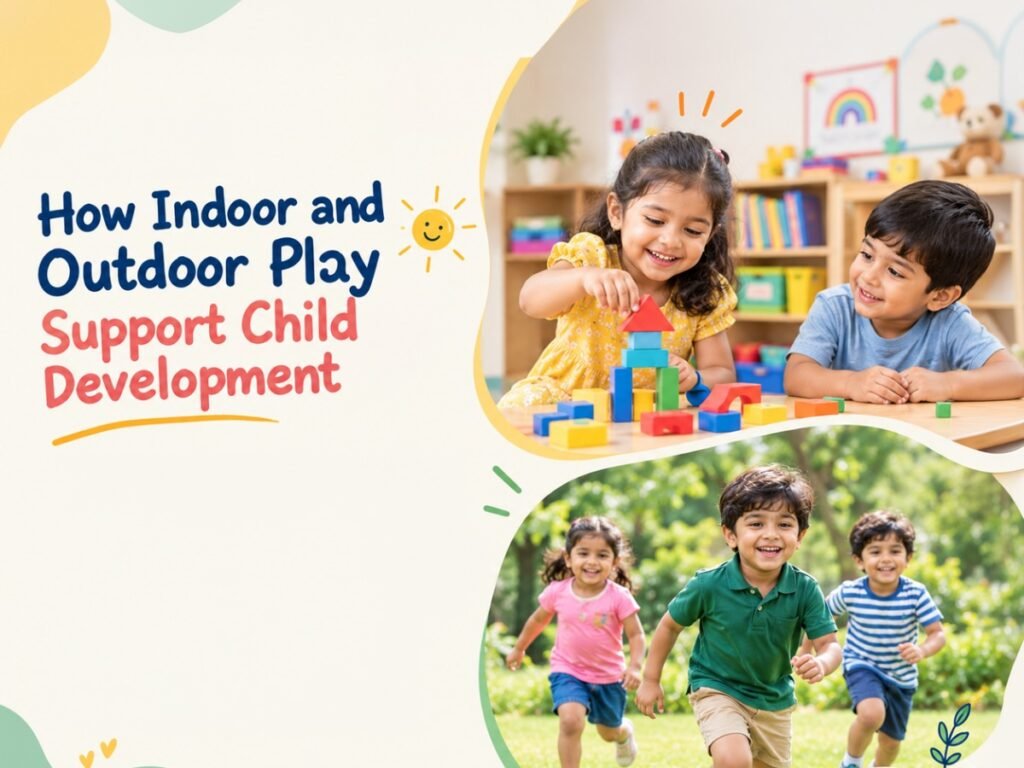
Children learn through everything they do. From building a tower with blocks to running across a playground, everyday play helps children explore the world, develop new skills, and understand how things work. Both indoor and outdoor play are important parts of early childhood development because they offer different experiences that support a child’s physical, social, emotional, and thinking skills.
At Akshaya Bala Kuteera, a trusted play based preschool in Bangalore, children are encouraged to learn through enjoyable and meaningful activities. As a play based preschool, Akshaya Bala Kuteera provides opportunities for indoor games, creative tasks, outdoor play, and classroom experiences that support children’s overall development. When children have opportunities to explore, move, create, and interact with others, learning becomes more natural and enjoyable. But how do indoor and outdoor activities help children develop? Why should both be included in a preschool routine? Let’s understand the benefits of indoor and outdoor play and how they support early learning. caring environment. When children have opportunities to explore, move, create, and interact with others, learning becomes more natural and enjoyable. But how do indoor and outdoor activities help children develop? Why should both be included in a preschool routine? Let’s understand the benefits of indoor and outdoor play and how they support early learning.
How Does a Play Based Preschool Support Child Development?
A play based preschool uses activities such as puzzles, blocks, art, and outdoor games to encourage learning. This approach helps children develop creativity, communication, and problem-solving skills. Through indoor and outdoor play, children can explore new ideas, practise important skills, and learn at their own pace. At Akshaya Bala Kuteera, play based learning gives children opportunities to learn through enjoyable and meaningful preschool activities. A play based preschool encourages children to participate in activities that support their physical, social, emotional, and cognitive development.
Play based learning can support:
- Early problem-solving skills.
- Communication and vocabulary.
- Creativity and imagination.
- Social interaction.
- Confidence and independence.
- Physical coordination.
The goal is not to make every activity a formal lesson. Children also need time to explore and enjoy playing in a safe and supportive environment. Teachers play an important role by observing children, providing suitable materials, encouraging participation, and helping children learn from their experiences.
How Does Indoor Play Support Child Development?
Indoor play gives children opportunities to explore, create, and learn in a comfortable learning environment. These activities can be planned around a child’s age, interests, and abilities. Indoor activities for preschoolers do not have to be complicated. Simple games with blocks, puzzles, books, art materials, and toys can encourage children to think and experiment.
1. How Does Indoor Play Improve Thinking Skills?
Indoor play often involves activities that encourage children to observe, remember, compare, and solve problems. For example, when a child completes a puzzle, they learn to identify shapes and understand how different pieces fit together. Building blocks can also support early mathematical thinking. Children may learn about size, height, patterns, and balance while creating their own structures.
Activities such as sorting objects by colour, matching pictures, and arranging toys in order can help develop concentration and logical thinking. These experiences are useful because children learn by doing rather than only listening to instructions.
2. How Does Indoor Play Encourage Creativity?
Creative play allows children to express their ideas freely. Drawing, painting, clay modelling, music, and pretend play give children opportunities to use their imagination. A child may draw a house, create a story about a toy, or build a small city using blocks. These activities encourage children to think creatively and explore different possibilities.
Creative activities also help children develop confidence. When children are given the freedom to make choices, they begin to understand that their ideas are valuable. At a play based preschool, creative learning can be included in the daily routine through simple activities that are enjoyable and suitable for different age groups.
3. How Do Indoor Activities Improve Fine Motor Skills?
Fine motor skills involve the small movements of the hands and fingers. These skills are important for everyday tasks such as holding a pencil, turning pages, using scissors, and handling small objects.
Indoor activities for preschoolers that support fine motor development include:
- Drawing and colouring.
- Building with blocks.
- Threading beads under supervision.
- Playing with clay.
- Puzzles and matching games.
- Tearing and pasting paper for craft activities.
These activities help children practise hand control and coordination. Regular practice through play can make everyday tasks easier as children grow.
4. How Does Indoor Play Support Language and Social Skills?
Indoor play often gives children time to talk, listen, and interact with their teachers and friends. Storytelling, role play, group games, and pretend cooking can encourage communication. For example, children playing with toy kitchen sets may pretend to prepare food, serve meals, and talk about their roles. Through this type of play, they practise using words, expressing ideas, and understanding others.
Group activities also teach children how to take turns, share materials, and cooperate with friends. These experiences help create a positive foundation for social development.
What Are the Benefits of Outdoor Play for Preschool Children?
Outdoor play gives children the freedom to move, explore, and experience the world around them. It offers opportunities for active movement and learning through real-life surroundings.
Running, jumping, climbing, balancing, and playing simple outdoor games can support physical development. Outdoor play can also encourage curiosity, teamwork, and confidence. The benefits of indoor and outdoor play are different, but both contribute to a child’s overall growth.
1. How Does Outdoor Play Improve Physical Development?
Outdoor activities encourage children to use their whole body. Running, jumping, throwing, and balancing help children practise movement and coordination. These activities support the development of gross motor skills, which involve larger body movements.
Examples of outdoor play include:
- Running and chasing games.
- Jumping over safe obstacles.
- Ball games.
- Balancing activities.
- Playground movement games.
- Simple group races.
Children do not need to perform difficult exercises. Age-appropriate movement and regular opportunities to be active can help them become more comfortable using their bodies. Outdoor play can also make physical activity enjoyable, helping children develop positive habits from an early age.
2. How Does Outdoor Play Build Confidence?
Outdoor play gives children opportunities to try new activities and face small challenges. A child may initially hesitate to climb, balance, or join a group game. With encouragement, they may gradually become more confident. When children complete a task or learn a new movement, they experience a sense of achievement. This can encourage them to try other activities.
Teachers can support this process by offering safe challenges and allowing children to progress at their own pace. Outdoor play should be enjoyable and supportive rather than focused on competition.
3. How Does Outdoor Play Encourage Social Interaction?
Children often play together outdoors, making it a useful setting for social learning. Group games encourage children to communicate, follow simple rules, and work as a team. For example, children may play a ball-passing game where they learn to wait for their turn. They may also work together to complete an outdoor activity or create a pretend game.
These experiences help children practise:
- Sharing and taking turns.
- Listening to others.
- Cooperating with friends.
- Solving small disagreements.
- Understanding group rules.
Such skills can support positive relationships as children move through their early learning years.
4. How Does Outdoor Play Develop Curiosity?
Outdoor environments offer many things for children to observe. Leaves, flowers, insects, stones, shadows, and changes in weather can all become opportunities for exploration. A teacher may ask children why leaves have different shapes or what happens when water is poured onto soil. These simple questions can encourage observation and curiosity.
Outdoor learning can therefore connect play with early science and nature awareness. Children begin to understand the world through direct experiences.
What Is the Difference Between Indoor and Outdoor Play?
Indoor and outdoor play support child development in different ways. Indoor play often provides opportunities for creative activities, quiet concentration, puzzles, and structured learning. Outdoor play encourages movement, exploration, and active social interaction. However, these benefits are not limited to one environment. Children can also develop creativity outdoors and practise physical coordination indoors.
| Indoor play | Outdoor play |
|---|---|
| Puzzles and matching games | Running and movement games |
| Drawing and craft activities | Ball games and balancing |
| Blocks and construction | Playground exploration |
| Storytelling and pretend play | Nature-based activities |
| Fine motor practice | Gross motor development |
| Quiet concentration | Active movement and exploration |
The best approach is to offer children a balance of both. A play preschool curriculum can include indoor and outdoor experiences according to the children’s age, interests, and daily needs.
How Can a Play Based Preschool Include Both Activities?
A well-planned play based preschool routine gives children opportunities to learn through different types of activities. Instead of depending only on worksheets or classroom instruction, teachers can use play to introduce important concepts.
For example, a preschool day may include:
Indoor learning: Children explore puzzles, blocks, art, stories, and creative activities.
Outdoor learning: Children participate in movement games, playground activities, and nature exploration.
Group learning: Children sing songs, listen to stories, and interact with friends.
Free play: Children choose suitable activities and explore their interests with teacher guidance.
This balance allows children to experience different learning styles throughout the day.
A play preschool curriculum should be flexible enough to support children at different developmental stages. Younger children may need more simple sensory and movement activities, while older preschoolers may enjoy more complex puzzles, creative tasks, and group games.
Why Is Play Based Learning Important in Preschool?
Play based learning preschool programs help children understand concepts through enjoyable experiences. When children are interested in an activity, they are often more willing to participate and explore. For example, a teacher can introduce counting through blocks, colours through art, and communication through pretend play. These activities make learning practical and engaging.
Play based learning can support:
- Early problem-solving.
- Communication and vocabulary.
- Creativity and imagination.
- Social interaction.
- Confidence and independence.
- Physical coordination.
The goal is not to make every activity a formal lesson. Children also need time to explore and enjoy playing preschool in a safe and supportive environment. Teachers play an important role by observing children, providing suitable materials, encouraging participation, and helping children learn from their experiences.
How Can Parents Encourage Indoor and Outdoor Play at Home?
Parents can support child development by offering simple opportunities for both indoor and outdoor play. Children do not always need expensive toys or complicated activities.
At home, parents can encourage indoor play through:
- Reading picture books together.
- Building with blocks.
- Drawing and colouring.
- Playing matching and sorting games.
- Creating simple pretend-play activities.
Outdoor play can include walking in a safe area, playing with a ball, exploring nature, or enjoying age-appropriate playground activities. It is helpful to let children choose some activities based on their interests. Parents can also join their children during play, ask questions, and encourage them to explain what they are doing. For outdoor activities, adults should choose safe environments and provide supervision appropriate to the child’s age and abilities.
How Does Play Support Emotional Development?
Play gives children opportunities to express feelings and understand different situations. Through pretend play, storytelling, and group activities, children may explore emotions such as happiness, sadness, excitement, and frustration. For example, a child may use dolls or toys to act out a situation involving sharing or helping a friend. This can provide an opportunity to talk about feelings and appropriate ways to respond.
Indoor and outdoor play can both support emotional growth. Children may feel proud after completing a puzzle, excited while playing outdoors, or happy when cooperating with friends. Teachers and parents can support emotional development by listening to children, encouraging them, and helping them name their feelings.
Why Should Parents Choose a Preschool With Indoor and Outdoor Play?
When choosing a preschool, parents may look for an environment that supports learning, physical activity, creativity, and social development. A preschool that includes both indoor and outdoor play can offer children varied learning experiences throughout the day.
Parents may consider:
- Safe and age-appropriate play areas.
- Caring and supportive teachers.
- Indoor creative and learning activities.
- Outdoor movement opportunities.
- A balanced daily routine.
- Opportunities for social interaction.
- Clean and comfortable learning spaces.
The right preschool should provide activities that match children’s developmental needs rather than expecting every child to learn in the same way. For parents looking for a preschool in Bangalore, Akshaya Bala Kuteera provides a nurturing environment where children can explore, learn, and develop through meaningful early childhood experiences.
Conclusion
Indoor and outdoor play are both important for a child’s early development. Indoor activities help children explore creativity, concentration, fine motor skills, and problem-solving. Outdoor activities encourage movement, coordination, confidence, and social interaction. Together, these experiences create a balanced learning environment where children can grow through play. A good play based preschool understands that children learn best when they have opportunities to explore, ask questions, create, and enjoy their experiences.
At Akshaya Bala Kuteera, children are encouraged to learn through meaningful activities in a caring preschool environment. Through play based learning, indoor activities, and outdoor experiences, the preschool supports children as they build essential skills for their early years. To learn more about the preschool and its early learning approach, visit Akshaya Bala Kuteera.
Frequently Asked Questions
1. What are the benefits of indoor and outdoor play?
Indoor and outdoor play support different areas of child development. Indoor play encourages creativity, concentration, fine motor skills, and problem-solving. Outdoor play supports physical movement, coordination, confidence, and social interaction.
2. Why is play based learning important for preschoolers?
Play based learning helps children understand concepts through enjoyable activities. It encourages curiosity, creativity, communication, and problem-solving while allowing children to learn at their own pace.
3. What are some indoor activities for preschoolers?
Some indoor activities for preschoolers include puzzles, drawing, colouring, building blocks, storytelling, clay modelling, matching games, and pretend play.
4. How does outdoor play help children develop?
Outdoor play encourages children to move, explore, and interact with others. It supports gross motor skills, coordination, confidence, teamwork, and curiosity about the surrounding environment.
5. What should a play preschool curriculum include?
A play preschool curriculum can include creative activities, indoor learning, outdoor play, stories, music, movement games, social interaction, and age-appropriate learning experiences.
6. How much indoor and outdoor play should preschoolers get?
Children benefit from regular opportunities to play both indoors and outdoors. The right balance depends on their age, routine, environment, weather, and individual needs. Preschools should provide age appropriate activities with time for active play and rest.