

7 Ways Preschool Teachers Use Children's Interests to Guide Learning
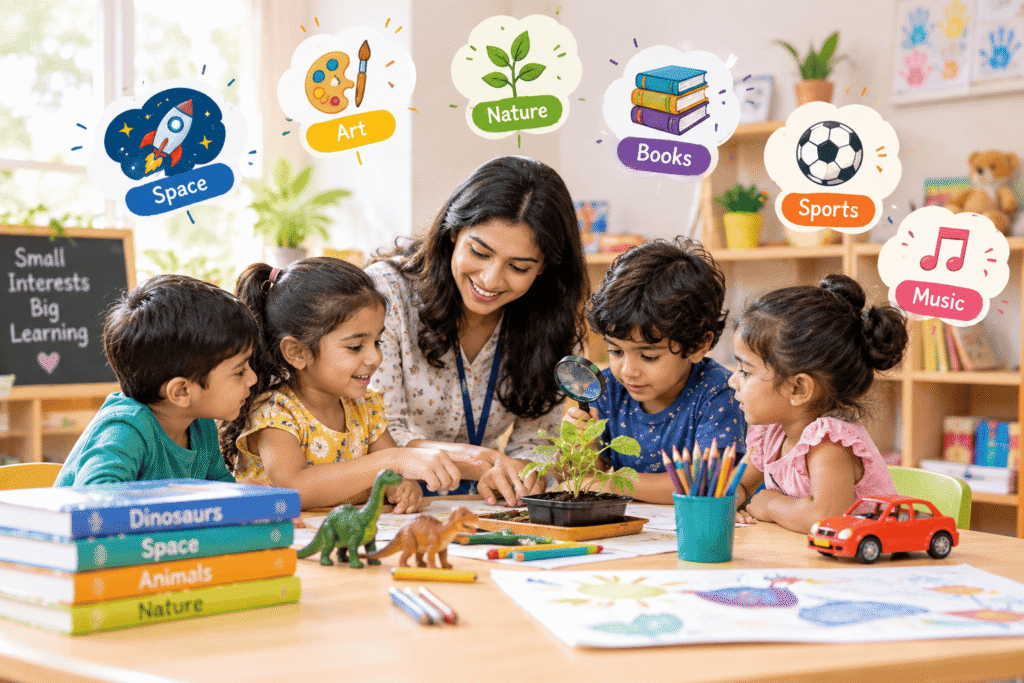
Every child has unique interests, questions, and ways of exploring the world. Some children enjoy building with blocks, while others love drawing, listening to stories, exploring nature, or playing with friends. Understanding these interests helps teachers create meaningful learning experiences that keep children curious and engaged. Child-led learning in preschool allows teachers to use children’s natural curiosity as a starting point for learning new skills and ideas.
At Akshaya Bala Kuteera, a preschool in Bangalore, learning is supported through play, creativity, and guided activities. By observing what children enjoy, how they interact with others, and which activities hold their attention, preschool teachers can better understand their learning needs. These observations help teachers plan activities that support cognitive, social, emotional, and physical development while making learning enjoyable.
In this blog, we explore seven ways preschool teachers observe children’s interests and use those observations to guide classroom learning.
What Is Child-Led Learning in Preschool?
Child-led learning in preschool is an approach that allows children’s interests, questions, and curiosity to influence their learning experiences. Instead of following only a fixed set of activities, teachers provide opportunities for children to explore topics that naturally attract their attention.
However, child-led learning does not mean children learn without guidance. Teachers provide suitable materials, ask thoughtful questions, and introduce new concepts to extend children’s understanding. This approach combines children’s choices with purposeful teaching.
Why Do Teachers Observe Children's Interests?
Observation helps teachers understand how children learn, what they enjoy, and where they may need additional support. Children do not always express their interests through words. Their actions, play choices, questions, and interactions can reveal what captures their attention.
Through observation-based learning in preschool, teachers can:
Identify activities that encourage curiosity and participation.
Understand children’s developing skills and individual learning needs.
Recognise opportunities to introduce new concepts.
Encourage children who are hesitant to participate.
Plan learning experiences that connect with children’s interests.
Notice changes in children’s confidence, behaviour, and preferences.
The National Association for the Education of Young Children (NAEYC) highlights observation and documentation as important parts of understanding children’s development and planning meaningful learning experiences. When teachers observe children regularly, they can make classroom activities more relevant instead of relying on the same approach for every child.
1. How Do Teachers Observe Children During Play?
Play provides valuable opportunities for teachers to understand children’s interests. During free play, children often choose activities based on their curiosity, imagination, and experiences. A child who repeatedly builds towers with blocks may enjoy construction and problem-solving. Another child who spends time pretending to run a shop may be interested in role-play, communication, and social interaction.
Teachers observe these choices without interrupting the child’s exploration unnecessarily.
What teachers look for:
Which toys, materials, or activities children choose most often.
How long children remain interested in an activity.
Whether they prefer playing alone, with a partner, or in a group.
How they solve problems when something does not work.
Whether they repeat an activity or try different approaches.
These preschool teaching methods make learning more engaging because activities connect with what children already enjoy.
2. How Do Teachers Recognise Children's Questions and Curiosity?
Children’s questions often provide clues about what they want to understand. Questions such as “Why does it rain?”, “Where do ants live?” or “How do plants grow?” can become starting points for meaningful learning. Teachers listen carefully to these questions and look for opportunities to explore the topic through stories, experiments, discussions, and hands-on activities. This approach supports interest-based learning activities for preschoolers by turning everyday curiosity into opportunities for discovery.
Teachers can encourage further thinking by asking simple questions such as:
What do you think will happen next?
Why do you think that happened?
What could we try differently?
How can we find out?
These questions encourage children to think, make predictions, and explain their ideas. They also help teachers understand children’s existing knowledge and identify suitable next steps.
3. How Do Teachers Use Conversations to Understand Interests?
Conversations help teachers learn what children are thinking about, what they enjoy, and which experiences are important to them. Some children openly share their ideas, while others may need time and gentle encouragement. During classroom discussions, story time, or everyday interactions, teachers listen to children’s comments and notice recurring topics.
Teachers can support these interests through simple, open-ended conversations.
“What did you enjoy about that?”
“Can you tell me more about your idea?”
“What would you like to explore next?”
“How could we make something like that?”
These conversations help teachers understand children’s perspectives without assuming that every child has the same preferences. They also support language development, vocabulary, listening skills, and confidence. By responding thoughtfully, teachers show children that their ideas are valued.
4. How Do Teachers Record Children's Learning Progress?
Observations become more useful when teachers record what they notice. Instead of relying only on memory, teachers can maintain simple notes about children’s interests, participation, questions, and progress. This documentation helps teachers recognise patterns over time and plan suitable activities.
Common observation methods include:
Anecdotal notes: Short descriptions of something a child said or did.
Work samples: Drawings, paintings, constructions, or other examples of children’s work.
Observation checklists: Records of specific skills or behaviours observed during activities.
Learning portfolios: Collections of children’s work and observations that show progress over time.
Photographs of activities: Images that document a child’s work or learning process, following appropriate consent and privacy practices.
Observation records should describe what actually happens rather than label children. They help teachers understand each child’s progress, not compare children unnecessarily.
5. How Do Teachers Turn Children's Interests Into Learning Activities?
Once teachers understand children’s interests, they can plan activities that connect those interests with important learning goals.
This is one of the most practical applications of child-led learning in preschool. A familiar topic can introduce early mathematics, language, creativity, science, and social skills.
Here are a few examples:
If a child enjoys animals:
Count toy animals to practise early mathematics.
Sort animals by size, colour, or habitat.
Read animal stories to develop vocabulary.
Create animal pictures using crayons or clay.
If a child enjoys building:
Build towers using blocks of different sizes.
Compare which structures are taller or shorter.
Explore shapes, balance, and patterns.
Work with classmates to build a shared structure.
If a child enjoys music:
Clap along to different rhythms.
Identify fast and slow sounds.
Sing songs that introduce new words.
Create simple musical instruments using safe materials.
If a child enjoys nature:
Collect and compare fallen leaves.
Observe plants and insects.
Sort natural objects by shape or size.
Draw pictures of things found outdoors.
These examples show how preschool learning activities can develop several skills through a single area of interest. Teachers can adapt the activity according to children’s ages, abilities, and responses.
6. How Do Teachers Encourage Children With Different Interests?
Not every child enjoys the same activities. Some children prefer physical movement, while others enjoy quiet activities such as puzzles, drawing, or looking at books. Effective preschool teaching methods recognise these differences. Teachers provide a variety of learning opportunities so that children can explore their preferences without feeling pressured to participate in the same way.
Children can explore the same topic through different activities, allowing them to participate according to their interests and developing skills. Teachers should also introduce new experiences gradually. A child who usually chooses drawing may discover an interest in gardening when invited to decorate plant pots or observe growing seeds.
The goal is not to limit children to their existing preferences. It is to use those preferences as a starting point for exploration, while offering opportunities to discover something new.
7. How Do Teachers Adjust Learning Based on Their Observations?
Observation is an ongoing process. Children’s interests can change as they gain new experiences, develop skills, and interact with others. Teachers review their observations and adjust classroom activities accordingly. If children lose interest in an activity, the teacher may introduce different materials, change the level of difficulty, or explore another related topic.
Teachers also observe whether an activity is too easy or too challenging. If children complete a task quickly, they can introduce an additional challenge. If children struggle, they can simplify the task or provide more guidance. This responsive approach helps teachers balance children’s interests with learning objectives.
Regular communication with families can provide further insight. Parents may share what their child enjoys at home, such as cooking, music, gardening, or storytelling. Combining these insights with classroom observations helps teachers plan more relevant experiences.
How Does Observation-Based Learning Support Child Development?
Observation-based learning in preschool helps teachers understand children’s individual strengths and provide suitable opportunities for growth.
Cognitive development: Activities based on children’s interests encourage reasoning, memory, sorting, counting, and problem-solving.
Language development: Conversations, storytelling, and questions introduce vocabulary and encourage children to express their thoughts.
Social development: Group activities based on shared interests help children cooperate, take turns, listen, and exchange ideas.
Emotional development: When teachers recognise children’s preferences and respond positively, children can feel heard, valued, and more comfortable participating.
Physical development: Activities such as building, painting, gardening, and movement games support fine and gross motor skills.
These benefits depend on the quality of the learning experience, the child’s developmental stage, and the guidance provided by teachers. Observation helps educators make informed decisions about how to support each area of development.
How Can Parents Help Teachers Understand Their Child's Interests?
Parents know their children in different settings and can share useful information about their preferences, questions, and everyday experiences.
To support child-led learning in preschool, parents can:
Tell teachers about activities their child enjoys at home.
Share recurring questions or topics that interest their child.
Encourage drawing, storytelling, pretend play, and outdoor exploration.
Allow children to try activities without expecting perfect results.
Discuss new interests or changes in behaviour with teachers.
Share relevant cultural and family experiences that may support classroom learning.
When parents and teachers exchange observations, they can create stronger connections between home experiences and classroom learning.
Conclusion
Understanding children’s interests helps preschool teachers make learning more meaningful, engaging, and relevant. Through careful observation, conversations, play, and documentation, teachers can identify what captures children’s attention and use those interests to introduce new skills and experiences. Child-led learning in preschool does not mean leaving children to learn on their own. It means combining their natural curiosity with thoughtful guidance, purposeful activities, and opportunities to explore new ideas.
At Akshaya Bala Kuteera, a preschool in Bangalore, play, creativity, and guided learning can help children explore their interests while developing essential skills. When teachers pay attention to what children enjoy and how they learn, everyday classroom experiences can become valuable opportunities for discovery and growth.
Frequently Asked Questions
1. Why is observing children important in preschool?
Observation helps teachers understand children’s interests, developmental progress, strengths, and learning needs. It also supports activity planning and helps teachers provide appropriate guidance.
2. What are examples of child-led learning in preschool?
Examples include exploring a child’s interest in animals through stories and puzzles, using blocks to explore shapes and balance, and investigating plants through gardening activities.
3. How do preschool teachers identify children's interests?
Teachers observe children’s play choices, listen to their questions, notice recurring activities, review their work, and communicate with families to understand what engages each child.
4. What is the difference between child-led and teacher-led learning?
Child-led learning begins with children’s interests and choices, while teacher-led learning follows activities or goals introduced by the teacher. Preschool classrooms can combine both approaches to provide balanced learning experiences.
5. How does play-based learning help preschoolers?
Play-based learning gives children opportunities to explore ideas, practise skills, solve problems, communicate with others, and learn through hands-on experiences.
6. How can parents support learning based on their child's interests?
Parents can provide opportunities for exploration at home, listen to their child’s questions, share interests with teachers, and encourage activities that develop curiosity, creativity, and independence.